11. Periods
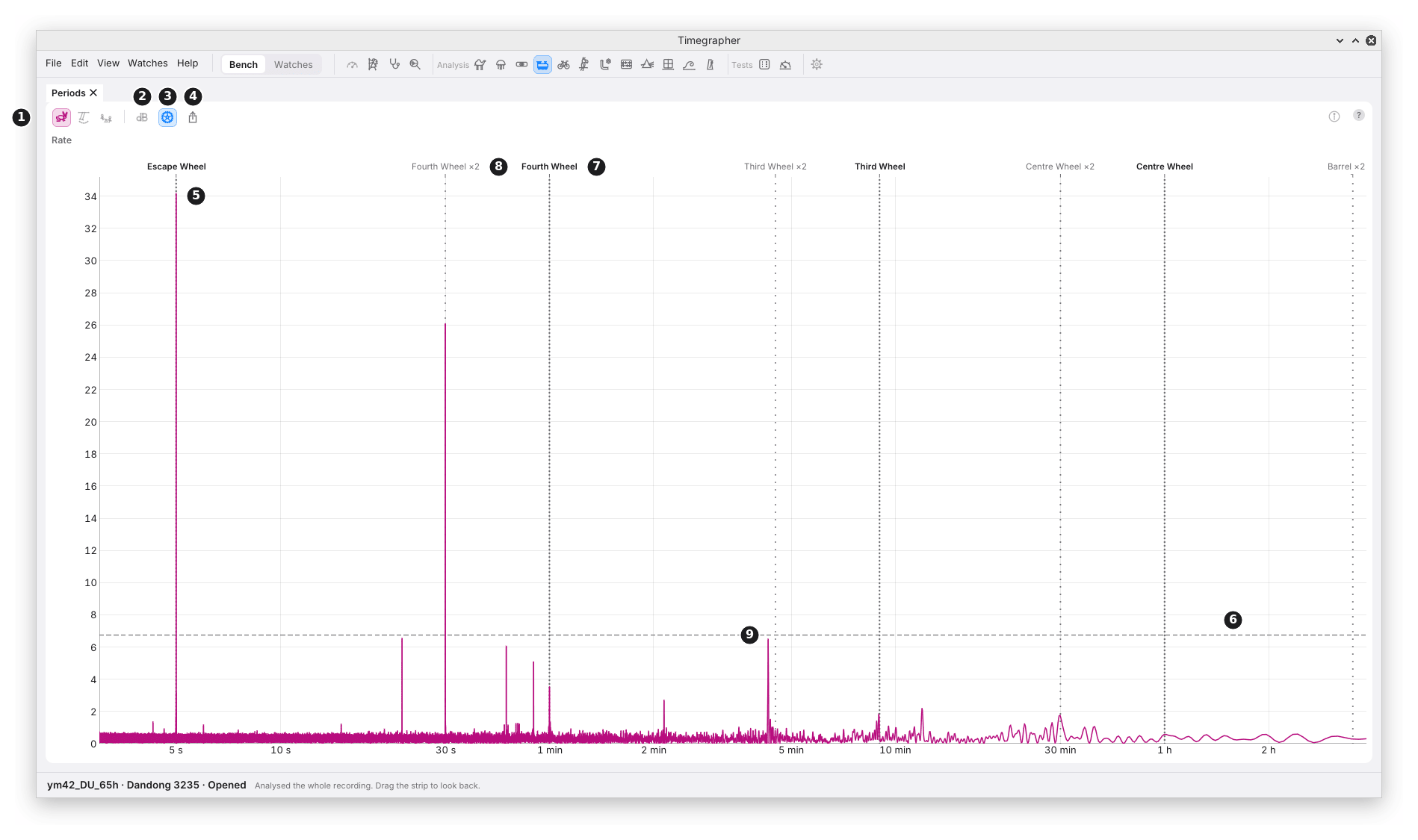
What it shows: how strongly the readings repeat at each period, from seconds up to many minutes, on a log scale. A tall, narrow line is a period the readings repeat at. The calibre’s wheels’ periods are marked across it.
Why you’d use it: anything that turns with a wheel and disturbs the beat once a turn shows here as a line at that wheel’s period. This is where you look for a fault that comes and goes on a regular beat.
The Toolbar
| Mark | Control | What it does | Why you’d use it |
|---|---|---|---|
| 1 | Rate, Amplitude, Beat Error | Show or hide each series. | Rate alone at first. A fault at a wheel can show in one series and not another. |
| 2 | dB Scale | Draws the scores in decibels below the tallest, from 0 dB at the top down to −30 dB. Off: linear. | A small line beside a tall one still shows. |
| 3 | Wheel Periods | Marks the calibre’s wheels’ periods. On at first, and one setting for this pane only. | To match a line to a wheel. |
| 4 | Export… | Saves the pane as a picture. |
The Plot
| Mark | Part | What it shows |
|---|---|---|
| 5 | The strongest line | When the search keeps a line, the strongest kept gets a dot and a note: its period and, when it matches one, the wheel whose turn it matches, “5 s, Escape Wheel”. In the picture no line is kept (below), so the mark is on the tallest. |
| 6 | The dashed line | The score a period needs for the search to list it: its 1% false-alarm level over the whole search. |
| 7 | A wheel’s period | A grey dotted line, named above the plot (inside its top on a short pane). |
| 8 | Half a wheel’s period | A fainter dotted line marked ×2: where a wheel that is off centre shows, twice a turn. Not drawn where another wheel already turns at that period. |
| 9 | Another line | A line away from the wheels’ marks. Here 4 min, just under the dashed line: the cycle Cycle folds (chapter 12). |
With no calibre picked, or none of its wheels known, one minute and one hour are marked in grey instead.
In the picture are the first 12 hours of the Dandong 3235 run-down from chapter 8. Two lines stand far above the rest, each exactly on a wheel’s mark. The tallest is at 5 s, the escape wheel’s turn (it turns once in twice its teeth in beats: 20 teeth at 28,800 bph give 5 s, 15 teeth give 3.75 s). The next is at 30 s, half the fourth wheel’s minute, with a smaller line at the minute itself. A disturbance that is sharp rather than smooth spreads over the harmonics of its period, a half, a third, a quarter of it, and they can stand taller than the period itself. So in a few seconds’ look the plot points at two wheels of the train, the escape wheel and the fourth wheel, and at nothing in between.
Yet no line has a dot, and the headline names only the level change at 47 minutes (chapter 15). The plot shows each period’s score before any line is taken out; a line is kept only if, once the stronger ones are taken out, it still passes the dashed line, explains at least 0.5% of the movement in the beat timing, and passes the correction across every test (chapter 9). Here the 5 s line is the tallest, so it is picked first, and still it is not kept: it explains under 0.5% of the beat timing’s movement once the slow change is taken off. A tall score is not by itself a named line.
How It Is Worked Out
- On the watch’s own clock. Each beat is placed at its number times the nominal beat period. A wheel turns once in a fixed number of beats (the fourth wheel every 480 beats at 28,800 bph), so on this clock its period is exact even when the rate changes.
- Slow change taken off first, with a running median over 30 minutes (a quadratic for takes under 20 minutes), so the mainspring running down isn’t read as a long cycle.
- Each period is scored with its harmonics, its first 1, 2, 4 or 8, whichever scores best. A smooth cycle scores best on one; a short dip once a turn scores best on eight.
- The strongest period is taken out and the search repeats, so one fault isn’t listed at several periods.
- A line is listed only when it passes the dashed 1% line, explains at least 0.5% of the variation, and passes Holm’s correction across every test (chapter 9).
- A line matches a wheel when their periods agree to within 1%, or to the take’s resolution (the period squared over the take’s length), whichever is wider.
The rate is searched on the beats’ timing, so its lines can be far faster than the 10 s readings: the escape wheel’s line is a swing in the timing of the beats, given in ms, that no 10 s reading would show. The amplitude and the beat error are searched on their 2 s windows, from 16 s up.
What to Look For
| What you see | What it can mean |
|---|---|
| No line over the dashed line | Nothing repeats strongly enough to name. |
| A line at a wheel’s period | The readings repeat once per turn of that wheel. |
| A line at half a wheel’s period | Twice a turn: what an off-centre wheel can give. |
| Lines at a half, a third and a quarter of a wheel’s period | A sharp disturbance once per turn of that wheel. |
| A line at no wheel’s period | A repeat from something else: the room, the stand, or a wheel the calibre table doesn’t list. |
What It Can’t Tell You
- Which part is at fault. A line at a wheel’s period says the readings repeat with that wheel’s turn; it doesn’t say whether the wheel, its pinion or something turning with it is the cause.
- Slow wheels in a short take. A cycle needs several turns inside the take. The 5-minute takes show no line over the dashed line: five turns of the fourth wheel are too few to tell a cycle from slower wander.
- Long periods. Periods longer than about half the 30-minute running median are weakened by it, so a barrel’s turn of hours isn’t found here.
- How big the swing is. The score is how sure the search is, not how large the swing. The Cycle view (chapter 12) and the Info panel give the size.
Previous: Readings Over Time · Next: Cycle
This page comes from the app's user guide at v1.0.1. See it on GitHub.