12. Cycle
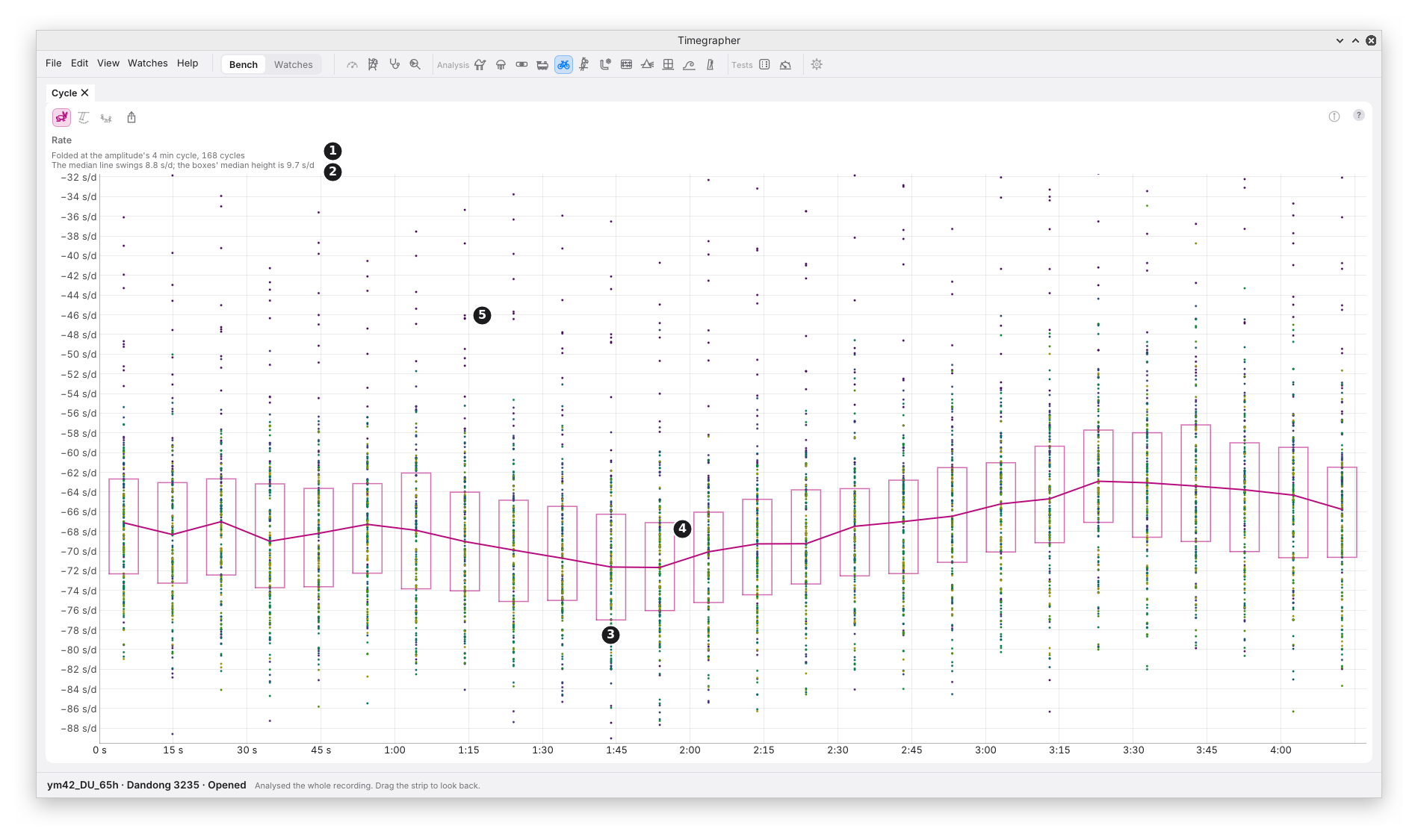
What it shows: the readings folded at one period, so each cycle is laid over the one before. Along the bottom is the time into the cycle, from 0 to one period. The line is the cycle’s typical shape.
Why you’d use it: Periods says the readings repeat at a period. Cycle shows what one repeat looks like: a smooth wave, or a dip at one point in the turn. It also shows how big it is, and whether it held through the take.
| Mark | Part | What it shows |
|---|---|---|
| 1 | What it is folded at | The period, and where it came from (below), with the number of cycles folded. |
| 2 | The swing | How far the median line swings, highest less lowest, beside the boxes’ median height. |
| 3 | A box | The middle half of the readings at that point of the cycle. Drawn where a point has at least four readings. |
| 4 | The median line | The median reading at each point of the cycle: the cycle’s typical shape. |
| 5 | A reading | One reading at its place in the cycle, coloured by when its cycle came: purple for the first, through to yellow-green for the last. |
What it is folded at, in this order:
- The series’ own cycle, when the tests found one or the period search listed one: “60 s cycle, Fourth Wheel, 30 cycles folded”.
- Another series’ cycle, when this series has none: “Folded at the amplitude’s 4 min cycle, 168 cycles”, as in the picture. It then shows whether the same cycle is in this series too.
- The longest wheel’s turn that fits, when no series has a cycle: “Folded at the third wheel’s 9 min turn, 4 cycles”.
A period is used only when it is at least three readings long and the take holds at least two turns of it.
Reading the Swing
The note compares two sizes:
- The swing of the median line: how big the cycle is.
- The boxes’ median height: how much the readings scatter at each point of the cycle.
A real cycle swings well clear of the scatter: the line’s swing is large beside the boxes’ height, and the boxes follow the line. With few cycles folded, the line can zigzag with the scatter of a few readings at each point; with many, the scatter averages out and a smaller cycle shows.
In the picture are the first 12 hours of the Dandong 3235 run-down from chapter 8. The tests found a 4-minute cycle in the amplitude (chapter 9), and none in the rate, so the rate is folded at the amplitude’s cycle: 168 cycles laid over each other. The rate follows it. The line falls to about −72 s/d near 1:45 into the cycle and rises to about −63 s/d near 3:30, one smooth swing of 8.8 s/d, and the boxes move with it. Each reading scatters about as much (the boxes are 9.7 s/d high), so no reading, and no card, would show this swing; folding 168 cycles does. The dots of every colour lie mixed together, so it held through the 12 hours. Four minutes matches none of the wheel periods the calibre table gives for this movement (chapter 11 marks them).
What to Look For
| What you see | What it can mean |
|---|---|
| A smooth wave, the boxes following it | A steady cycle through each turn. |
| A flat line with one dip or bump | A short event once a turn. |
| The same shape in every colour | The cycle held through the take. |
| The shape in early colours only | The cycle faded during the take. |
| A zigzag, boxes as tall as the swing | No cycle at this period: scatter. |
What It Can’t Tell You
- Whether the cycle is real. Folding draws a shape from any readings at any period. Whether the cycle is there is the period search’s call (chapter 11) and the headline’s.
- A cycle faster than the readings. The rate’s readings are 10 s long; a cycle under 30 s is shown in Periods and the FFT from the beat timing instead.
Previous: Periods · Next: Autocorrelation
This page comes from the app's user guide at v1.0.1. See it on GitHub.