18. Wavelet Map
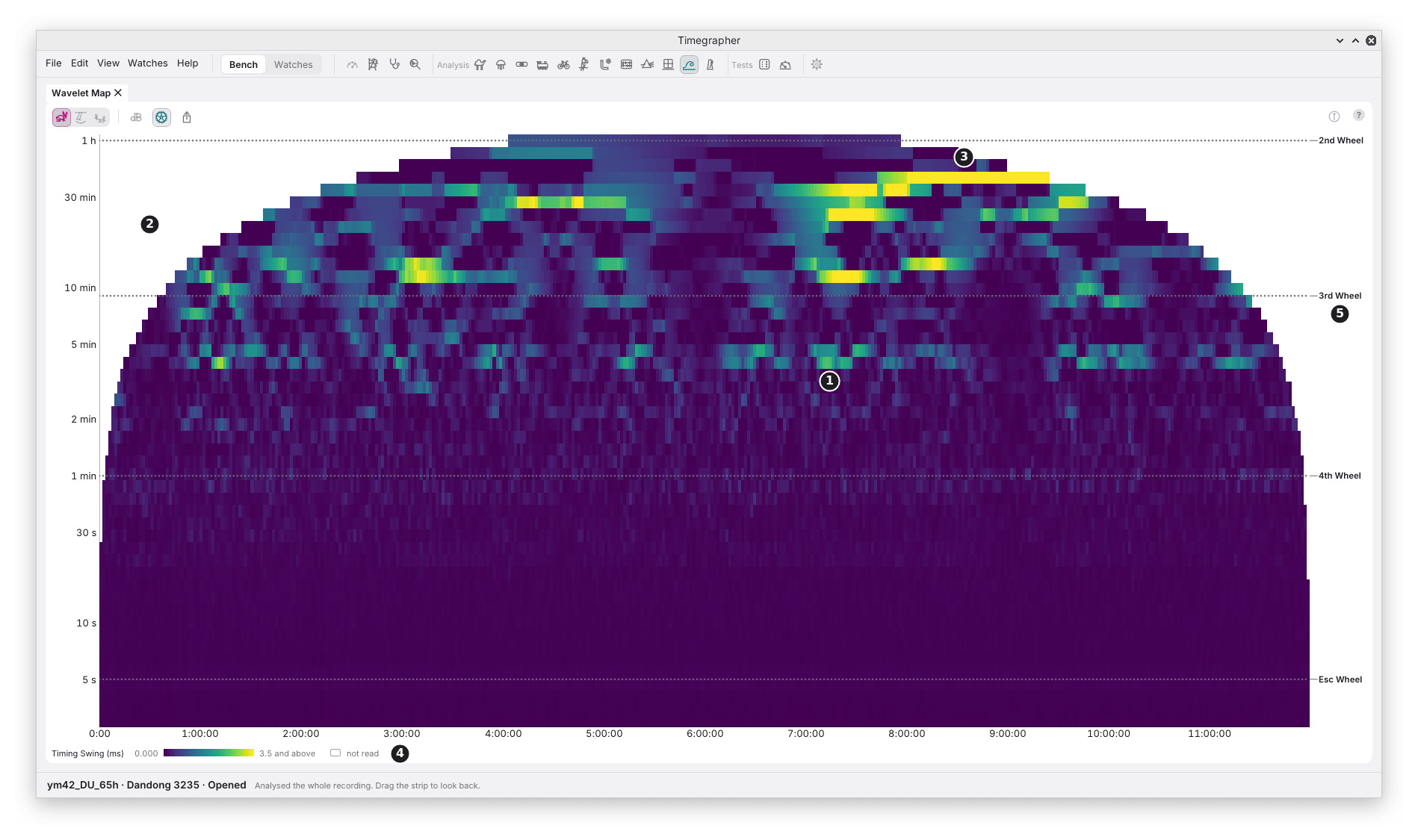
What it shows: like the STFT Map (chapter 17), the size of each period’s swing at each time of the take: period up the side, on a log scale, time across, size as colour. It is made from a wavelet transform. A wavelet is a short burst of a wave, a few swings long; the transform slides one along the readings at each period, stretched to fit, and records how well it matches. So it reads each period over a time to suit it: short periods over a short time, long ones over a long time.
Why you’d use it: to see sharply where and when a swing is. A fast swing is placed to within seconds, not to within a 20-minute window, and each swing is sharpened towards its true period. It also reaches longer periods than the STFT Map, up to an hour. Use it to find the moment a swing started or stopped, or a brief event, and the STFT Map to read how big a swing is.
The picture is the same 12 hours as chapter 17’s, on the plain scale.
The toolbar is the STFT Map’s (chapter 17): the series, chosen together with the STFT Map, dB Scale for this map, Wheel Periods and Export…. The pointer over a cell gives its size, period and time.
| Mark | Part | What it shows |
|---|---|---|
| 1 | Bursts along one period | A swing at one period that comes and goes: here near 4 to 5 minutes, bright in some hours and faint in others. |
| 2 | The empty edge | Not read. Near each end of a stretch, a period’s wavelet would reach past the readings, so the cells there are left empty. Long periods need more room, so the read area is a dome: its cone of influence. |
| 3 | Bright cells at long periods | A slow swing: here the beat timing wandering over 10 to 40 minutes. |
| 4 | The key | As the STFT Map’s: Timing Swing (ms) for the rate’s map, from 0 up to the size 99.5% of the cells read stay under. |
| 5 | A wheel’s name | The wheels’ short names, level with their lines. |
Two more things can show. A gap in the readings splits the map: each unbroken stretch is read alone, with its own dome. A stripe up the map is something brief that touched every short period at once. The take in the picture has neither.
In the picture, the 4-minute swing that Cycle folds (chapter 12) shows as a row of patches near 4 to 5 minutes. It is not steady: it comes in bursts, brightest near 1, 5, 6½ to 7 and 10 to 11 hours, and faint between, which the Cycle view, laying all 168 cycles together, can’t show. Above it, swings of 10 to 40 minutes flare and fade: the slow wander of the timing, brightest from about 7 to 9 hours. The escape wheel’s steady 5 s line (chapter 17) is too small to show on this scale.
How It Is Worked Out
- A Morlet wavelet (a short wave inside a bell-shaped envelope) is slid along the readings at each period. Its length grows with the period, so every period is read over the same number of its own turns.
- Synchrosqueezed: each value is moved to the period its own phase turns at, which pulls a spread-out line in towards its true period.
- Each unbroken stretch alone, of at least 64 readings. Nothing is read across a gap.
- Periods up to an hour, or a quarter of the longest unbroken stretch, whichever is shorter, from 4 readings up. A very long stretch is averaged down first, to keep the work bounded.
- Sizes are a sine’s size, half its peak to peak. Under noise the sharpening spreads a line over neighbouring rows, so one row reads less than the line’s size: read the size from the STFT Map.
M11 explains the method and its trade-offs.
What to Look For
| What you see | What it can mean |
|---|---|
| A line across at a wheel’s period | That wheel’s swing, through the take. |
| A line that breaks off or starts | A swing that stopped or began: the map says when to within a few of its turns. |
| A stripe up the map | A brief event: a knock, a noise in the room, a missed beat. |
| Bright cells at the top | Slow wander or drift in the series. |
| An empty map, “needs a longer stretch of unbroken readings” | No stretch is long enough: too many gaps. |
STFT Map or Wavelet Map?
| You want | Use |
|---|---|
| How big a swing is | The STFT Map: every period read over the same 20 minutes. |
| When a swing started, stopped or changed | The Wavelet Map. |
| A brief event | The Wavelet Map. |
| Periods over 400 s | The Wavelet Map, or the FFT. |
What It Can’t Tell You
- The size, closely. Under noise one row reads under the line’s size.
- Anything near a stretch’s ends at long periods: the cone leaves them empty.
- The cause of a stripe. A knock, a noise and a missed beat look alike.
- Whether a line is real. That is the period search’s call (chapter 11).
Previous: STFT Map · Next: Isochronism
This page comes from the app's user guide at v1.0.1. See it on GitHub.